If you are going to put Mesopotamia vocabulary on trial, you need a judge. And who better than the man who literally wrote the book on it?
Around 1754 BCE, King Hammurabi of Babylon had 282 laws carved into a tall stone stele and set up where his people could see them. It is one of the oldest written law codes we have, and it gave us the idea that the rules should be written down, public, and the same for everyone who came before the court. So when it came time to build a clue game for Mesopotamia vocabulary, Hammurabi got the gavel.
And yes, if you are old enough to remember Laugh-In, you already know where the title came from. Here come de judge.
How a case works
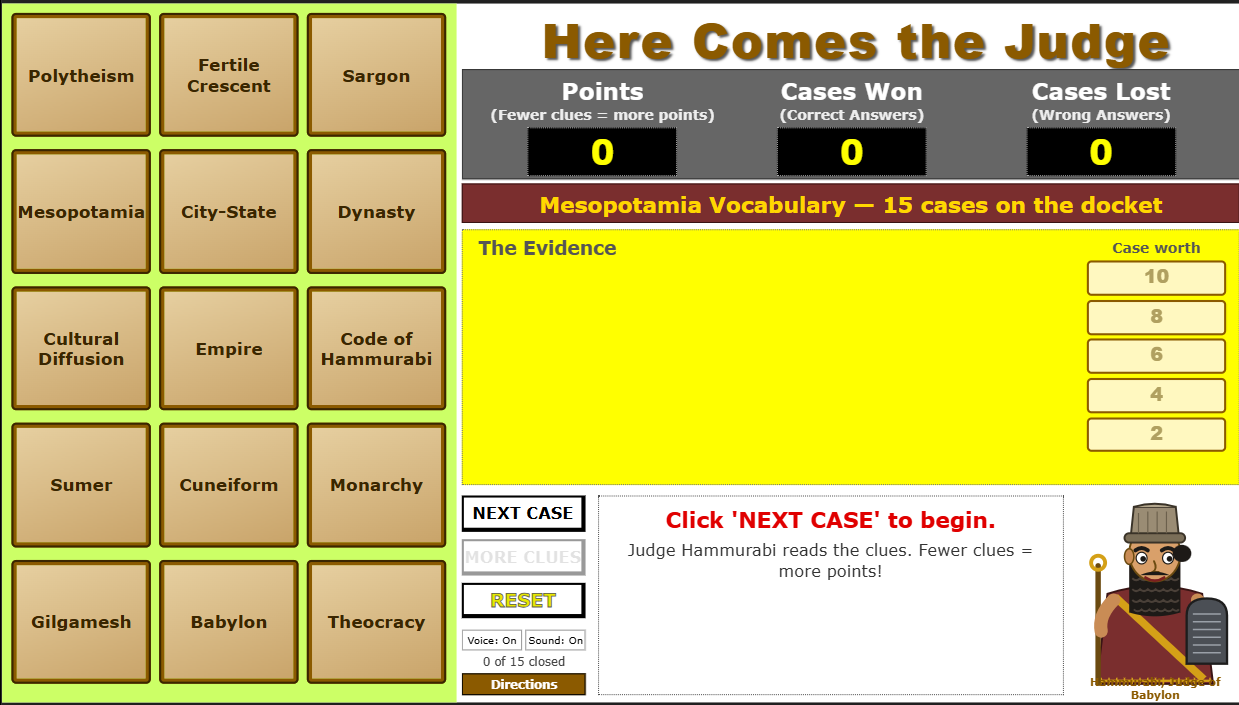
- Fifteen cases are on the docket: Polytheism, Fertile Crescent, Sargon, Mesopotamia, City-State, Dynasty, Cultural Diffusion, Empire, Code of Hammurabi, Sumer, Cuneiform, Monarchy, Gilgamesh, Babylon, and Theocracy.
- Click Next Case and Judge Hammurabi reads the first piece of evidence aloud.
- Know it? Click the matching term on the board. Not sure? Ask for More Clues, but every clue lowers what the case is worth: 10, 8, 6, 4, then 2 points.
- Right answers go in the Cases Won column. Wrong ones go in Cases Lost. Fewer clues means more points.
It works great on a projector with the class calling out answers, or one-on-one as a review before the test. Voice and sound can each be switched off if you are in a quiet room.


Leave a comment